Double Taxation: How to Avoid It Using International Tax Agreements in 2026
When your business earns income in a foreign country, two governments may claim the right to tax it. In most cases, that's legal. In most cases, it's also preventable — if you know which treaty applies, which relief method to use, and what the anti-abuse rules now require you to prove. This guide explains the mechanics for businesses with international operations.
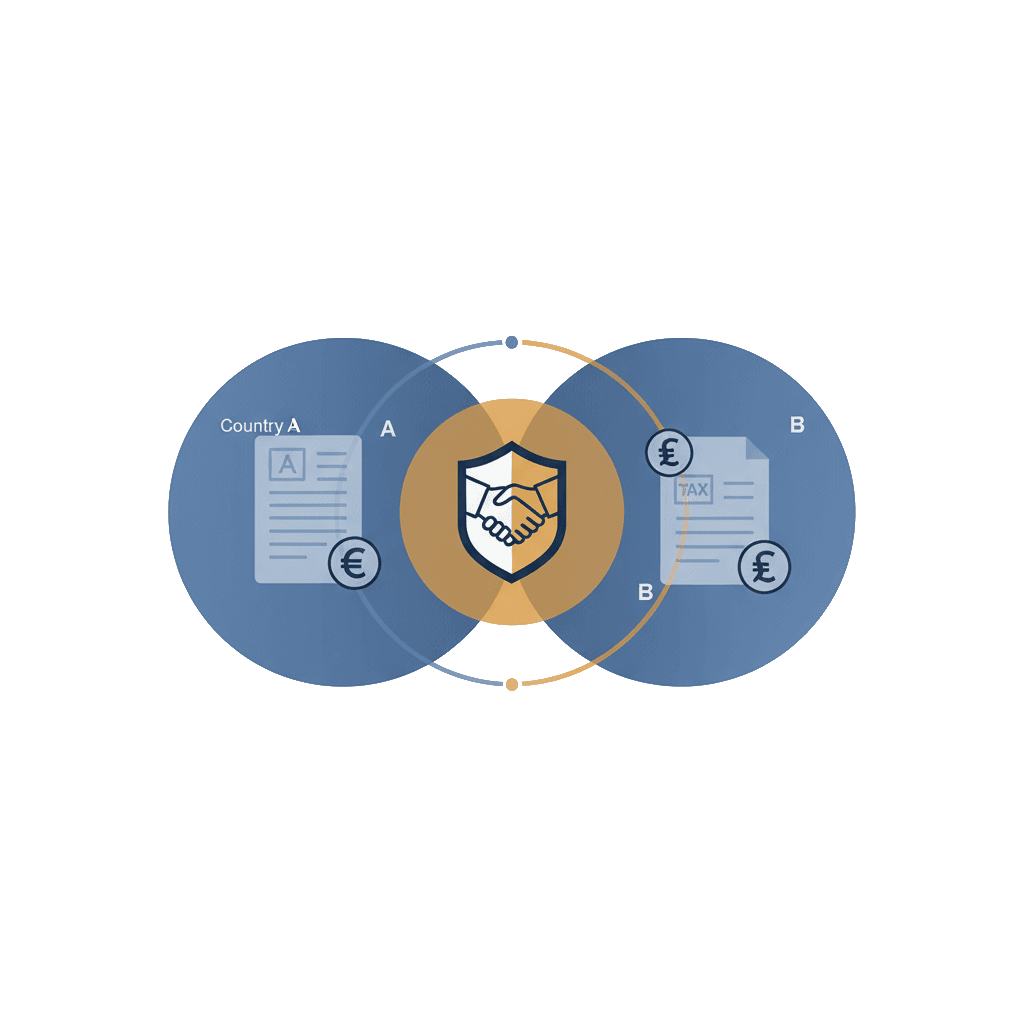
How Double Taxation Happens — and the Two Ways to Fix It
Jurisdictional vs. Economic Double Taxation
There are two distinct types. Jurisdictional double taxation — the kind treaties are designed to prevent — occurs when two countries both tax the same income of the same taxpayer. A French company receiving dividends from its US subsidiary faces US withholding tax and French corporate tax on the same distribution. Economic double taxation occurs when the same income is taxed twice at different levels — for example, corporate profits taxed at the company level, then again as dividends when distributed to shareholders. Tax treaties primarily address jurisdictional double taxation. Economic double taxation (the corporate/dividend chain) is addressed separately through domestic rules like participation exemptions, dividends-received deductions, and pass-through treatment. Most countries address it through one of two relief methods: the exemption method (the foreign income is simply excluded from taxation in the residence country) or the credit method (the foreign income is taxed in the residence country, but the foreign tax paid is credited against the domestic liability). Which method applies depends on the specific treaty and domestic law — and in most cases, you have a choice.
Jurisdictional double taxation: same income taxed in two countries — the primary target of tax treaties
Economic double taxation: same profits taxed at corporate level, then again as dividends — addressed by domestic exemptions and deductions
Exemption method: foreign-source income excluded from residence-country tax — simpler, cleaner, but all-or-nothing
Credit method: foreign income included in residence-country tax base, but foreign taxes paid offset the liability dollar-for-dollar (or equivalent)
Over 5,100 bilateral tax treaties in force globally as of 2025 (OECD Corporate Tax Statistics)
Tax Treaties: What They Actually Do
The Core Mechanics of a Bilateral Tax Agreement
A tax treaty (also called a Double Tax Agreement or DTA) is a bilateral contract between two countries that allocates taxing rights over specific categories of income. Most treaties follow either the OECD Model Tax Convention or the UN Model Convention, so their structure is broadly consistent — though the specific rates and carve-outs vary significantly between any two countries. The treaty's key functions for businesses are: reducing withholding tax rates on cross-border payments of dividends, interest, and royalties below the statutory rate; clarifying that business profits of a resident of one country are only taxable in the other country if the business has a permanent establishment there; establishing residency tie-breaker rules for entities resident in both countries; providing a Mutual Agreement Procedure (MAP) through which businesses can request resolution of double-taxation disputes between the two tax authorities; and setting rules for when employment income, pensions, capital gains, and other income categories are taxable in each country. The treaty does not replace domestic law — it limits it. Domestic rules still apply; the treaty provides relief above and beyond what domestic law would otherwise allow. To access treaty benefits, you must meet residency requirements, hold beneficial ownership of the income, and — since the MLI — satisfy the Principal Purpose Test (PPT) or a Limitation on Benefits (LOB) clause.
The Saving Clause: The US-Specific Trap
The US is one of only a handful of countries that taxes its citizens on worldwide income regardless of where they live. Every US tax treaty includes a saving clause that preserves the US's right to tax its own citizens and residents as if the treaty didn't exist. This means that for US citizens and US-resident corporations, treaties often provide less relief than expected. The Foreign Tax Credit (FTC) and Foreign Earned Income Exclusion (FEIE) — domestic tools built into US tax law — frequently provide more practical double-taxation relief than the treaty itself. The US also chose not to sign the OECD Multilateral Instrument (MLI), so US treaty positions are unaffected by the MLI's anti-abuse provisions — though the treaty partners' positions may have changed.
Withholding Tax Rates: Statutory vs. Treaty-Reduced (Key Markets, 2026)
| Payment Type | US Statutory Rate | US–UK Treaty Rate | US–Germany Treaty Rate | US–Netherlands Treaty Rate | US–Singapore Treaty Rate |
|---|---|---|---|---|---|
| Dividends (portfolio investor) | 30% | 15% | 15% | 15% | 15% |
| Dividends (qualifying corporate shareholder ≥10%) | 30% | 5% | 5% | 5% | 5% |
| Interest | 30% | 0% | 0% | 0% | 0% |
| Royalties (general) | 30% | 0% | 0% | 0% | 5% |
| Business profits (no US PE) | 30% FDAP / net basis on ECI | Exempt | Exempt | Exempt | Exempt |
Treaty rates shown are indicative for qualifying beneficial owners meeting residency, substance, and documentation requirements. The Principal Purpose Test or Limitation on Benefits clause may deny these rates if treaty access lacks a genuine business purpose. Always confirm current treaty text and any MLI modifications. Rates as of 2026.
The Two Relief Methods: Credit vs. Exemption
Foreign Tax Credit: Dollar-for-Dollar Relief
The credit method allows you to offset your residence-country tax liability by the amount of tax already paid in the source country — dollar for dollar, or equivalent. In the US, this is the Foreign Tax Credit (FTC), claimed on Form 1116 for individuals and Form 1118 for corporations. The credit is limited to the US tax on the foreign income — you can't use it to reduce US tax on US-source income. If the foreign tax rate exceeds the US rate, the excess credit can generally be carried back one year and forward up to ten years. Under the OBBBA (signed July 4, 2025), the indirect FTC on net CFC tested income was raised to 90% for corporations for tax years beginning after December 31, 2025 — increasing relief against residual US tax on global profits. The credit method is almost always superior in high-tax jurisdictions like Germany, France, or the UK, where foreign tax rates frequently exceed US rates. In these cases, the credit eliminates the US liability entirely and may generate a carryforward.
US corporations: claim FTC on Form 1118; individuals on Form 1116
Credit limited to US tax attributable to foreign-source income — cannot offset US tax on US-source income
Unused credits: carry back 1 year, carry forward 10 years (except GILTI income, which cannot be carried)
OBBBA (effective for tax years after December 31, 2025): indirect FTC on net CFC tested income raised to 90%
FTC applies to both earned and passive income — broader than the FEIE, which covers only earned income
Exemption Method: Clean but Binary
Under the exemption method, the residence country simply excludes foreign-source income from its tax base. The income is taxed only in the source country. This is the dominant approach in many European countries and in the EU participation exemption, which exempts qualifying dividends received by parent companies from their subsidiaries from corporate tax. For US individuals, the Foreign Earned Income Exclusion (FEIE) is the closest equivalent — it excludes up to $132,900 of foreign earned income from US taxable income for 2026 (up from $130,000 for 2025). Unlike the FTC, the FEIE doesn't require foreign taxes to have been paid. It works better in low-tax or zero-tax jurisdictions where little foreign tax is available to credit. The FEIE covers only earned income — wages, salaries, self-employment. Dividends, interest, and rental income don't qualify. You can combine both: apply FEIE to the first $132,900 of earned income, then claim FTC on the excess or on passive income. You cannot apply both to the same dollar of income.
FEIE 2026: excludes up to $132,900 of foreign earned income from US tax (earned income only)
FEIE is better in low-tax or zero-tax countries (UAE, Cayman, Qatar) where there's little foreign tax to credit
FTC is better in high-tax countries (Germany, France, UK) where foreign rates exceed US rates
EU participation exemption: qualifying dividends from subsidiaries exempt from corporate tax in most EU member states
Can combine FEIE and FTC in the same year — but not on the same income
The FEIE + FTC Stack
Foreign earned income excluded from US tax in 2026 — then FTC handles the rest
The MLI and Anti-Abuse Rules: What Changed for Businesses
The Principal Purpose Test
The OECD Multilateral Instrument (MLI), signed by 104 jurisdictions as of January 2025, modified over 1,600 bilateral tax treaties to include new anti-abuse provisions. The most significant for businesses is the Principal Purpose Test (PPT), now a minimum standard applied across most MLI-covered treaties. Under the PPT, treaty benefits — including reduced withholding rates — can be denied if obtaining those benefits was one of the principal purposes of the arrangement. This matters for any structure that routes dividends, interest, or royalties through an intermediate holding company in a treaty-favorable jurisdiction. A Dutch holding company receiving royalties from a US licensee and claiming the 0% withholding rate under the US-Netherlands treaty must demonstrate that its Dutch presence serves a genuine commercial purpose beyond the tax benefit. If the only reason the Dutch entity exists is to access the treaty rate, the PPT allows the tax authority to deny the reduced rate and apply the full 30% statutory withholding. The test is subjective and facts-based — documented substance (local directors, real office, decision-making in the treaty country) is the primary defense. Note: the US has not signed the MLI, so the PPT is imposed by the treaty partner's position, not by the US. US companies operating into MLI-signatory markets face the PPT from the source country's side.
MLI signed by 104 jurisdictions (January 2025); modifies 1,600+ bilateral treaties
Principal Purpose Test (PPT): treaty benefits denied if obtaining them was one of the main purposes of the arrangement
Defense: documented economic substance — local directors, real office, decision-making authority, bank accounts
US has NOT signed the MLI — but US companies face PPT from source countries (UK, Germany, Netherlands, etc.) that have
Netherlands conditional WHT (25.8% in 2026): applies to interest/royalties routed to low-tax or blacklisted jurisdictions
Limitation on Benefits (LOB) clauses in US treaties perform a similar function — typically found in US–UK, US–Netherlands, US–Germany treaties
Country-Specific Notes: High-Traffic Business Relationships
Key Jurisdictions for 2026
Treaty networks differ substantially across markets. Here's what businesses with operations in major jurisdictions need to know for 2026.
US–UK: 0% withholding on interest and royalties between qualifying entities; 5% on qualifying corporate dividends (≥10% shareholding); 15% for portfolio dividends. MLI applies on the UK side — PPT effective for UK companies. Saving clause limits US citizens from using the treaty to escape US tax.
US–Germany: 0% withholding on interest and royalties; 5% on corporate dividends. Germany has an effective combined corporate tax rate of ~30% (15.825% CIT + municipal trade tax ~14–17%). FTC is the correct relief mechanism for US companies — German tax typically exceeds the US rate. Germany has signed but not yet completed MLI implementation for all treaty purposes.
US–Canada: 5% withholding on qualifying corporate dividends, 15% for others; 0% interest; 0% royalties for most IP. Canadian source income subject to 25% statutory withholding without the treaty. Social Security Totalization Agreement prevents dual contributions. Note: Canada and the US are reviewing treaty provisions as part of broader trade adjustments in 2025–2026.
US–Netherlands: 0% withholding on interest and royalties for qualifying entities; 5% qualifying corporate dividends. Dutch participation exemption eliminates corporate tax on qualifying dividends received. Conditional WHT of 25.8% applies if payments route onward to blacklisted jurisdictions. PPT applies from the Dutch side — substance requirements are actively enforced by Dutch tax authorities.
US–Singapore: 5% withholding on qualifying corporate dividends (≥10% shareholding); 0% interest; 5% royalties. Singapore's domestic dividend withholding rate is 0% (one-tier system). Singapore's extensive treaty network (90+ agreements) and 17% corporate rate make it a high-substance holding jurisdiction for Asia-Pacific operations.
No US treaty: Brazil (no DTA with the US — 30% statutory withholding rate applies to most payments), Hong Kong (no treaty — treated as non-treaty jurisdiction at 30%), Germany–UAE (expired December 31, 2021 — payments now governed by domestic law). Always verify whether a treaty is still in force before relying on treaty rates — several EU-EU treaties have been terminated in recent years.
How to Claim Treaty Benefits: Documentation Requirements
What You Must Have Before the Withholding Agent Pays
Reduced withholding rates don't apply automatically. The withholding agent — the company making the payment — must receive documentation confirming your eligibility before applying the treaty rate. Providing this documentation after the fact is possible in some jurisdictions but adds complexity. For payments from US sources: non-US recipients must provide Form W-8BEN (individuals) or Form W-8BEN-E (entities) to the withholding agent before payment. The form certifies residency in a treaty country, beneficial ownership of the income, and eligibility for the claimed rate. It typically remains valid for three years unless circumstances change. For LOB clauses: Form W-8BEN-E requires entities to check the applicable LOB test they satisfy (resident company, publicly traded company, active trade or business, etc.). Checking the wrong box — or failing to check any — results in the full 30% withholding rate. For tax residency certificates: most treaty countries require a Tax Residency Certificate (TRC) issued by the relevant tax authority as evidence of residence. In Germany, this is the Ansässigkeitsbescheinigung. In the UK, a certificate of residence from HMRC. In Singapore, a certificate of residence from IRAS. Get these before the fiscal year ends, not after.
US inbound payments: Form W-8BEN (individuals) or W-8BEN-E (entities) — file with the withholding agent before payment
Form W-8BEN-E: must specify the LOB category under the US treaty — missing this triggers 30% statutory rate
Tax Residency Certificates: required by most treaty countries; obtain annually from local tax authority
Beneficial ownership documentation: confirm the income recipient is the true owner, not an intermediary
Substance documentation for PPT: board minutes, local staff records, office lease agreements, bank accounts in treaty country
MAP procedure: if double taxation occurs despite treaty, submit a MAP request to both competent authorities — deadlines vary by treaty, typically 3 years from the triggering assessment